Lumescope logo Order now

Lumescope

See clearly in total darkness, up to 300 yards away

Lumescope is a pocket-size digital night vision monocular. Its built-in infrared light shows you what is out there on a moonless night, its 16x zoom brings it closer, and a press of a button saves it as a photo or a 1080p video.

  • Clear image with no moon or streetlight
  • Zoom up to 16x without walking closer
  • Record 1080p video and HD photos
  • Up to 8 hours on one USB charge
Order Lumescope now
  • Free US shipping
  • Ships within 48 business hours
  • 90-day money-back guarantee
4.7/5from verified buyers
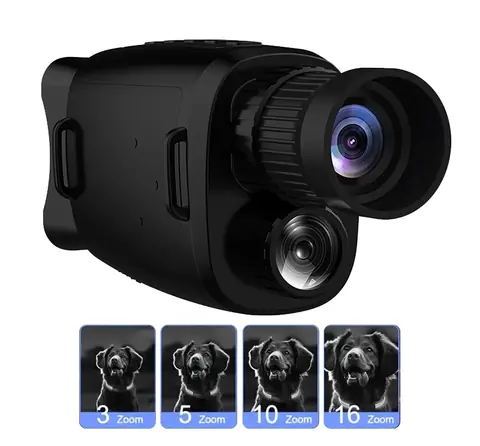
Lumescope night vision monocular with four sample views at 3x, 5x, 10x and 16x zoom

300yard range
in darkness

16xdigital
zoom

What does Lumescope do?

It turns a dark field, trail or shoreline into a picture you can actually read. Four things it does for you.

It shows you the dark
The infrared light and sensor build a sharp black and white image where your eyes see nothing at all.
It brings things closer
Four zoom steps up to 16x let you tell a deer from a coyote at the far end of the field without walking closer.
It keeps a record
Save HD photos or 1080p video of what crossed your yard at 2 a.m. and replay it the next morning.
It lasts the whole night
Up to 8 hours of use per charge, and it refills from any USB wall plug, laptop or power bank.

After sunset, most of what happens outdoors is invisible to you. A flashlight shows a small bright circle, flattens everything behind it and tells every animal within a hundred yards exactly where you are.

Human eyes need visible light, and on a cloudy or moonless night there is almost none. A regular monocular or pair of binoculars does not change that: it magnifies the light that reaches it, so when there is no light, it magnifies darkness. That is why most people simply stop looking once the sun goes down.

Lumescope takes a different route. A 3 W infrared illuminator sends out light your eyes cannot see, and a high-sensitivity infrared sensor picks up what bounces back. The result appears on a 2-inch HD screen behind a rubber eyecup: a clear black and white view of the field, the treeline or the water, out to about 300 yards. Nothing around you is lit up, so the raccoon at the edge of the lawn keeps doing what it was doing.

In daylight the same device works as a color monocular with 16x digital zoom, so it is just as useful at noon on a boat as it is at midnight on the porch.

Who is Lumescope for?

Anyone who spends time outdoors after dark, or who wants to know what moves around their home at night. Six groups get the most out of it.

  • Backyard wildlife watchers. Foxes, owls, deer and raccoons are most active at night. Lumescope lets you watch them from the porch without a light that sends them running.
  • Campers and hikers. Scan the campsite perimeter, check the trail ahead or find the noise behind the tent before you step out.
  • Anglers and boaters. Spot buoys, channel markers, docks and other boats on dark water, and keep an eye on your lines after sunset.
  • Rural homeowners. Check fences, barns, driveways and livestock areas from a window or the truck, without walking the property in the dark.
  • Stargazers. Move around a dark-sky site, find your gear and watch the horizon without switching on a white light that ruins everyone's night vision.
  • Hunters on scouting trips. Observe where game crosses and beds down at dusk and dawn. Lumescope is a handheld viewer made for watching, nothing else.

The common thread is simple: you want to see what is out there, from a distance, without announcing yourself with a beam of light.

Viewing modes

One scope, three ways to see

The same lens, sensor and screen, used three ways. Switching from one to another takes a single button press.

  1. Colordaytime

    Daylight color mode

    With the sun up, Lumescope shows a full-color picture and works like a compact zoom monocular. Useful for birds on the far bank, boats on the horizon or the next trail marker.

    • Natural colors in daylight
    • Zoom steps of 3x, 5x, 10x and 16x
    • Keeps working as the light fades at dusk
    Order Lumescope
  2. Most used

    300yards

    Infrared night mode

    After dark, the 3 W infrared illuminator lights the scene with light your eyes cannot see. The sensor turns it into a clear black and white image, even on a moonless night.

    • Viewing range up to 300 yards
    • 7 IR levels, from close to far
    • No visible beam to scare wildlife
    Order Lumescope
  3. 1080pvideo

    Photo and video capture

    Whatever is on the screen can be saved. Take an HD photo of a track by the creek or film a full minute of the family of foxes crossing your lawn, day or night.

    • Video in 1080p or 720p
    • HD still photos
    • Works in color and night mode
    Order Lumescope
Specifications

Why Lumescope beats a flashlight

A flashlight lights up a circle and gives you away. Lumescope shows the whole scene, from farther, without a visible beam. Here is what is inside.

  • Infrared illuminator icon

    3 W infrared illuminator, 7 levels

    The illuminator floods the scene with infrared light. Level 1 is enough for a porch or a campsite without washing out the image, level 7 pushes the view out to about 300 yards, roughly three football fields.

    Invisible to the eye
  • Zoom icon

    16x digital zoom

    Step through 3x, 5x, 10x and 16x with one button. Use the lower steps to follow something that moves and the higher ones to study something that stays put, like a deer bedded down at the edge of a field.

    4 zoom steps
  • HD screen icon

    2-inch HD screen behind an eyecup

    You look at a bright internal screen through a soft rubber eyecup. The cup blocks stray light and keeps the screen glow off your face, so the display does not light you up in the dark.

    Easy on the eyes
  • Video recording icon

    HD photos and 1080p video

    Take a still photo or start a video recording at the press of a button. Choose 1080p for the sharpest footage or 720p to save space. Handy for identifying the animal that keeps visiting your trash cans.

    Photo and video
  • Weather resistance icon

    IPX4 weather resistance

    The black ABS body shrugs off mist, splashes, light rain and damp night air. It is built for a wet dock or a foggy trail, not for being dropped in the lake.

    Rated IPX4
  • Battery icon

    Up to 8 hours per USB charge

    The built-in battery covers a full night outdoors. Recharge it from a wall adapter, a laptop, a car USB port or a power bank. No disposable batteries to buy or carry.

    USB rechargeable

How does infrared night vision work?

The idea is simple: bring your own light, but pick a kind of light that only the device can see.

Visible light is only a small slice of what is out there. Just beyond red sits near-infrared light, which human eyes cannot detect at all. Lumescope's 3 W illuminator sends a wide beam of it into the scene. To you, the yard stays dark. To the camera sensor, it is lit up.

The high-sensitivity sensor behind the lens records how much infrared light each point of the scene reflects back, and the processor turns that into a picture on the 2-inch HD screen. Because the sensor measures brightness rather than color, the night image is black and white. Leaves, fur and eyes reflect infrared well, which is why animals stand out so clearly and their eyes often glow on screen.

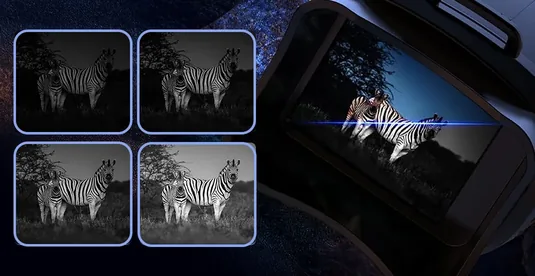
The same zebra shown four times at night, getting brighter as the infrared level goes up, next to the image as it appears on the Lumescope screen
Raising the IR level adds light to the scene: low levels for close subjects, high levels to reach far.

The 7 IR levels exist for a practical reason. A strong beam on something only a few yards away bounces back too much light and washes out the image. A weak beam on something far away never makes the round trip. You pick the level that matches the distance, and the picture stays sharp.

300 ydNight rangeAbout three football fields on level 7, in clear conditions.

7IR levelsFrom a soft glow for the porch to full power for the far treeline.

Range and brightness go together: the farther you look, the higher the level you need.

"A flashlight answers the question: what is right in front of me? Night vision answers a better one: what is out there that I did not know about? Most first-time users are surprised by how much was moving around them all along."

The Lumescope product team

What you notice on your first night out

First, depth. Instead of a bright spot and a black wall, you see the whole scene: the lawn, the fence line, the trees behind it, with shapes you can identify. Second, movement. Eyes reflect infrared strongly, so a cat under a car or a deer at the edge of the woods shows up as two bright dots long before you can make out the body.

Third, calm. Since nothing visible shines from your side, animals do not react to you. You get to watch them feed, cross and interact for minutes at a time, and you can record it to show the family the next morning.

Getting started

How to use Lumescope?

No manual to study and no settings menu to dig through. Three steps and you are watching the dark.

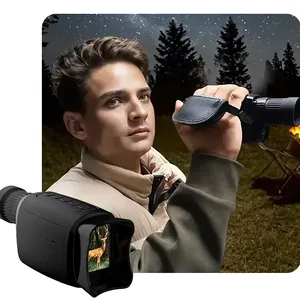
  1. A man outdoors at night holding the Lumescope monocular up to his eye with one hand

    Charge and power on

    Plug the USB cable into any charger until the battery is full, then switch the monocular on. Slip your hand through the strap and hold the eyecup gently against your eye.

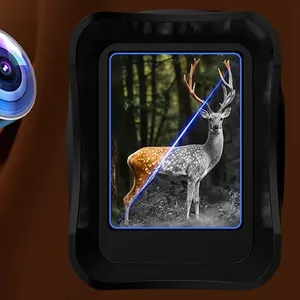
  2. Lumescope screen showing a deer, half of the image in daylight color and half in infrared night mode

    Set the infrared level

    Once it is dark, turn on night mode and pick an IR level. Start around level 2 or 3 for the yard, then raise it until the far end of the scene is bright and clear.

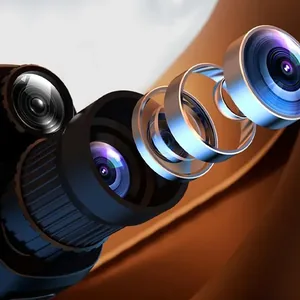
  3. Exploded view of the Lumescope lens stack showing the optical elements in front of the sensor

    Zoom, focus and record

    Step the zoom up to 3x, 5x, 10x or 16x, then turn the focus ring until edges look crisp. When something worth keeping appears, take a photo or start a video.

In the box

Everything you need for the first night

Charge it the day it arrives and it is ready to go out that same evening.

  • 1 Lumescope monocular Black ABS body with rubber eyecup, focus ring and hand strap attached.
  • 1 USB charging cable Works with a phone charger, a laptop, a car port or a power bank.
  • 1 quick start guide Buttons, IR levels, zoom steps and recording, explained on a single sheet.
Four night scenes seen through Lumescope: night sports, animal observation, outdoor adventures and night sky observation
Four ways owners put Lumescope to work after dark.
Side by side

Lumescope vs the older solutions

Most people head out at night with a flashlight or a regular monocular. Here is what each one can and cannot do in the dark.

Practical comparison with a typical handheld flashlight and a typical optical monocular, based on night viewing features.
FeatureFlashlightStandard monocularLumescope
Image in total darkness Beam area only Needs some light Up to 300 yd
Infrared illumination None None 3 W, 7 levels
Zoom None Fixed, limited 16x digital
Screen None Eyepiece only 2-inch HD
Photo and video None None Photo, 1080p
Stays discreet Bright beam No light No visible beam
Weather resistance Varies Varies IPX4
Power Varies by model None needed 8 h per USB charge

Swipe the table sideways to see every column.

Real situations

Lumescope in everyday life

It lives by the back door, in the glove box or in the tackle bag. Six moments where owners reach for it.

  • From the back porch, after 10 p.m.

    Find out what triggers the motion light: a raccoon, a stray cat or a doe with her fawns.

  • Around the campsite

    Scan the treeline before bed and check what that snapping branch was without leaving the tent.

  • On the water at night

    Pick out buoys, docks, anchored boats and your own bobbers on a black lake or bay.

  • Checking the property

    Look over the fence line, the barn and the driveway from the house before deciding to walk out.

  • At a dark-sky site

    Find your chair, your case and the path back to the car without a white light in anyone's eyes.

  • On a trail or ATV ride

    Stop and read the trail ahead at dusk, when headlights flatten ruts, rocks and turns.

Three habits for sharper night images

Lumescope works out of the box. These three habits are what separate a decent night image from a really clear one.

Match the IR level to the distance. More power is not always better. On a subject 10 yards away, level 7 bounces so much light back that faces and fur turn into white blobs. Start low, then step up one level at a time until the far edge of the scene is visible and the near part is not blown out.

Refocus every time you zoom. Focus that looks right at 3x will be soft at 10x. After each zoom change, give the focus ring a slow turn back and forth and stop where edges are crispest. Use 3x or 5x to follow an animal that moves, and save 10x and 16x for subjects that stay still.

Brace before you zoom in. At 16x, the smallest hand movement shakes the picture. Rest your elbow on a railing, a car roof or your knee, or lean against a tree. The image steadies at once, and so do your videos.

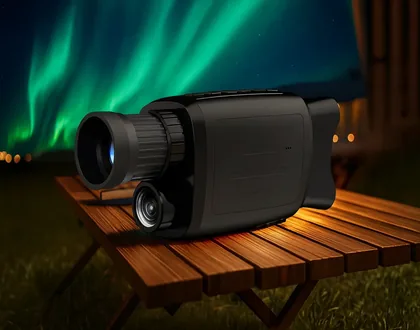
Lumescope resting on a wooden table outdoors under a green and violet northern lights sky
A table, a railing or a rock: any steady surface makes high zoom much more comfortable.

Good to know: charge Lumescope the evening before a trip and toss a small USB power bank in your bag. It tops up the battery in the field, so a long night of watching never ends early.

Limits worth knowing

Lumescope is a digital infrared viewer, and it is very good at that job. Here is what it does not do, so there are no surprises.

  • The night image is black and white. Color only appears in daylight mode. In infrared, you see shapes, contrast and detail, not colors.
  • 16x is digital zoom. The image gets softer at the highest steps. For the cleanest picture, stay at 3x to 10x and use 16x for a closer look at still subjects.
  • Range depends on conditions. Fog, heavy rain, snow and dust scatter the infrared beam and shorten the view. Very reflective surfaces close by, like road signs, can glare on screen.
  • It is not a thermal camera. It does not detect body heat and cannot see through walls, thick foliage or glass. Infrared also reflects off windows, so step outside or open the window.
  • Weather resistant, not waterproof. IPX4 covers splashes and light rain. Do not submerge it or leave it lying in a puddle.
  • Cold shortens battery life. Like any rechargeable battery, it holds less charge in freezing weather. Keep it in an inside pocket between uses.

Care and safe use

Wipe the lens and the screen window with a soft microfiber cloth, never with paper towels or solvents. If it gets wet, dry the body before putting it in a closed bag. Store it at room temperature and charge it with a standard USB adapter. Avoid aiming the illuminator straight into someone's eyes at close range, and keep the unit and its cable away from small children.

Respect people's privacy: use Lumescope to observe nature, your own property and open spaces, and follow the local rules that apply to wildlife and night activities where you are.

Buyer feedback

Lumescope user reviews

Rated 4.7 out of 5 by verified buyers. Here are six reviews that describe real situations in detail.

  • Profile photo of reviewer Dana W.

    Dana W.Asheville, NC, August 22, 2026

    Something kept knocking over our compost bin. First night with Lumescope on the deck, level 3 IR, I watched two raccoons and a possum take turns at it for almost an hour. I recorded a few clips and my kids have watched them way too many times.
    Verified buyer
  • Profile photo of reviewer Jordan T.

    Jordan T.Boise, ID, July 9, 2026

    Took it on a four-night camping trip in the Sawtooths. Every evening I did a slow scan of the meadow below camp and saw elk moving through twice. Battery lasted the whole trip with a quick power bank top-up on day three.
    Verified buyer
  • Profile photo of reviewer Casey L.

    Casey L.Lake Havasu City, AZ, June 14, 2026

    I night fish from a small boat and mostly use it to spot other boats and the no-wake buoys on the way back to the ramp. Works great for that. At 16x the image gets grainy, so I keep it at 5x most of the time. One star off for that.
    Verified buyer
  • Profile photo of reviewer Riley H.

    Riley H.Lubbock, TX, May 3, 2026

    We have 40 acres and a gate about 250 yards from the house. When the dogs start barking at night, I step out on the porch and check the gate and the pens before walking out there. Nine times out of ten it's coyotes along the far fence.
    Verified buyer
  • Profile photo of reviewer Morgan S.

    Morgan S.Flagstaff, AZ, April 18, 2026

    Our astronomy club has a strict no white light rule at the observing field. Lumescope lets me walk between telescopes and find my case in the truck without bothering anyone. Watching a pair of foxes cross the field at 1 a.m. was a nice bonus.
    Verified buyer
  • Profile photo of reviewer Taylor B.

    Taylor B.Annapolis, MD, March 27, 2026

    Handy when coming back into the harbor after dark, the mooring balls show up clearly well before the spotlight reaches them. Spray on deck has not been a problem. In March the battery ran down faster than the rated 8 hours, which the page warns about anyway.
    Verified buyer
Current offer

Order Lumescope here

One unit covers one person. The price per unit drops with each extra one: keep one in the truck and one at home, or give one to the angler or camper in the family.

  • 1 Lumescope

    One Lumescope night vision monocular, side view x1 Save 50%

    $89.95 per unit

    List price $179.90

    Total $89.95

    Order 1 Lumescope
  • Lowest unit price

    3 Lumescope

    Lumescope night vision monocular, pack of three x3 Save 64%

    $64.95 per unit

    List price $539.70

    Total $194.85

    Order 3 Lumescope
Accepted payment methods: major credit cards and PayPal

Checkout runs on an encrypted payment page. Orders leave the warehouse within 48 business hours with free US shipping, standard delivery takes about 2 to 3 business days, and a tracking link is sent as soon as the parcel ships. You then have 90 days to send it back for a refund if it is not for you.

Before you buy

Questions before you order

Range, image, recording, battery and delivery: the questions buyers ask most often.

Can Lumescope really see in complete darkness?

Yes. It does not rely on moonlight or streetlights. The built-in 3 W infrared illuminator lights the scene with light that is invisible to your eyes, and the sensor turns what it reflects into an image on the screen. It works on a cloudy, moonless night.

How far can I see at night?

Up to 300 yards, about three football fields, on the highest IR level and in clear weather. Fog, heavy rain or snow shorten that distance. For closer subjects, a lower IR level gives a cleaner, less washed-out picture.

Why is the night image black and white?

In night mode the sensor measures how much infrared light comes back from each point of the scene. Infrared carries brightness, not color, so the picture is monochrome. In daylight, Lumescope switches to a full-color image.

Is Lumescope a thermal camera?

No. It is a digital infrared night vision device: it lights the scene with infrared and shows the reflection. It does not detect body heat and cannot see through walls, dense foliage or glass. Infrared bounces off windows, so use it outdoors or through an open window.

Can it record what I see?

Yes. You can take HD photos and record video in 1080p or 720p, both in daylight color mode and in infrared night mode. What you record is exactly what you see on the screen, zoom included.

How long does the battery last, and how do I charge it?

Up to 8 hours of use on a full charge. It charges through the included USB cable from a wall adapter, a computer, a car port or a power bank. Battery life is shorter in freezing weather, as with any rechargeable battery.

Can I use it in the rain?

Light rain, mist, spray and humidity are fine: the body is rated IPX4. It is not waterproof, so it should never be submerged or left in standing water. Heavy rain also shortens the infrared viewing range.

How fast is delivery, and what if it is not for me?

Orders ship within 48 business hours and standard US delivery takes about 2 to 3 business days. A tracking link is sent when your parcel leaves the warehouse.

You are covered by a 90-day money-back guarantee: if Lumescope does not suit you, send it back within 90 days for a refund.

Lumescope digital night vision monocular with its hand strap

The night is full of things you have never seen. With Lumescope you watch them from 300 yards, zoom in up to 16x and keep the best moments on video, all from a device that fits in a jacket pocket. Try it for up to 90 days: if it does not earn its place in your gear, send it back.

Get my Lumescope
Get my Lumescope